Showing posts with label Reading at Random. Show all posts

Thursday, November 13, 2014

Falling Under by Danielle Younge-Ullman

I read Falling Under by Danielle Younge-Ullman at the very beginning of the year.  It was one of these hidden treasures that the randomizer rescued from the depths of my bookshelves that I really ended up liking.  Unfortunately, this validates that "I should give this a chance" point of view that keeps lots of books on my shelves taking up space for way, way too long.  Anyhow, it's been a while, so I don't actually remember it that well, but let me take a stab at some thoughts anyway.

Love triangles. We love them, we hate them. Falling Under has one, and it's a doozy. Mara Foster is a troubled artist, making a career of producing stock paintings of geometric designs to decorate peoples' offices. She used to paint other things, but other things awaken her emotions, and she's decided that her emotions are better off stifled. Mara is riddled with fears and anxieties that plague her whenever she dares to leave the safe confines of her house. Her parents' acrimonious divorce left a profound mark on her that leaves her terrified to love, so when she meets Hugo and dares to imagine a normal life with a normal guy, it threatens to undo her. Soon, she's painting for real and all that real painting is bringing the demons of her past close to the surface. She flees instead to Erik, the bad boy with baggage, the one she has plenty in common with, including a desire to eschew love for sex that will chase those demons away for a night.

Younge-Ullman, according to the author bio, is also a playwright and it shows. Falling Under is filled with fast flowing, excellent dialogue. Mara's past is brought to light in the immediacy of second person narration and easily draws readers' sympathies. There's a plot twist that actually surprises and supporting characters that fill out Mara's story while being their own people. I even liked the love triangle. It was so believable and viable that even I couldn't choose a guy for Mara. As far as I know, this is the only novel Younge-Ullman has written, but I hope she writes another, because I'd definitely be interested in reading more from her.

Miraculously, he loves you back. Though you're not quite sure he would if he really knew you, if he
knew the things you've done and the family you have and the sad, dark, panicky places that come out and haunt you at night. He would never understand how being happy makes you sad. How the happier you are the more you know the sky is about to explode into tiny, sparkling shards of glass that will pick up speed as they fall to the earth and slice right through you leaving your skin with little holes in it, leaving your heart bleeding.

(No disclaimer required for this one, either.  I'm pretty sure I won it from another blogger.  I can't remember who, but thanks who ever you were, it was excellent reading!)

Monday, November 10, 2014

Slam by Nick Hornby

It's November, I'm back, and I brought books (or, um, book reviews - you know what I mean)!

Nick Hornby's Slam is about Sam, the teenage son of a single mother who had him too young.  Sam, unfortunately, in the course of book, is about to follow in his mother's footsteps.  Sam's a pretty normal teenager, into skating (that's skateboarding for the uninitiated), preparing for the possibility of studying art at college, and, of course, spending all kinds of time with his superhot girlfriend, Alicia.  Everything is going along quite nicely, that is, until Alicia gets pregnant.

Slam's kind of a weird book.  Sam himself is, for the most part, a very normal teenage guy.  When faced with the staggering revelation of his girlfriend's pregnancy, he doesn't really know how to be supportive and kind of irrationally just wants to run away from the whole thing.  In short, he's inarticulate, obsessed with Tony Hawk, and he's kind of irritating - just like you would expect him to be at his age.  Then there's this weird plot thing where he consults with a poster of Tony Hawk for tidbits of life advice, which are tangentially related quips from Tony's book reproduced by Sam's overactive imagination, and the part with the supposed time travel (dreaming?) that reveals to Sam the various courses his life might follow as a too-young dad.

By turns bizarre and painfully realistic, Slam makes for some interesting reading.  Hornby seems to be spot on when he digs into the issues of teenage parenting, how unprepared kids are for the responsibility, how the parents eschew helping for debating over which kid ruined the other's life, as well as how quickly kids can age when they are forced to take on big responsibilities.  I liked these parts.  I liked that even though Sam's very colloquial narration reveals a character that, from a female perspective, is, on the whole, kind of aggravating, Hornby doesn't shy away from a creating a character who has very real and believable reactions to a very real and drastic turn of events in his life.

I could very well have done without all the weird Tony Hawk stuff, but even that, kind of points to Sam's immaturity that obviously doesn't go away just because he's about to become a father.  On the whole, being inside the head of a character I often couldn't decide whether I'd like to give a hug or a shove made it a little difficult to love this book, but Slam is definitely an interesting and rare look inside the male perspective on teenage pregnancy.

(No disclaimer today, friends.  I, like, bought this book - and read it, too!)

Thursday, July 17, 2014

Whistling in the Dark by Lesley Kagen

Ugh, I have been such crap at reviewing books for the last, oh, year and a half, that I am really letting some good ones get away from me.  I have a stack of great books sitting here on my desk that were great, that I meant to review, but instead are sitting here gathering dust while I forget the finer details that made me appreciate them.  I miss reviewing books and reviewing them well, and I tell you, it's hard to do when you read them months and months ago.  This is all a lead-in to say that I am about to try to do just such a thing.  Here's hoping an exceptional amount of rambling will get me to my destination.

I read Whistling in the Dark by Lesley Kagen a few months ago after either Random.org or the recently discovered "choose a random book of yours" feature on LibraryThing ordered me to rescue it from bookshelf oblivion.  For some reason, this almost always pays off for me.  Maybe it's because I buy a lot of great books and then ignore them for years, so when Reading at Random resurrects them, it's like getting a great new book all over again, except this time I actually read it.


Anyhow, as you can see, I'm procrastinating because I barely remember the book, but it's time to get serious now.  Whistling in the Dark is the story of sisters Sally and Troo O'Malley and the revelatory summer that changes their lives forever.  Sally is ten years old in 1959, recently moved to Milwaukee with her mom and no-good stepfather after the death of her father in a car accident that left her uncle severely brain-damaged.  During the summer of '59, she and her younger sister's lives are thrown into turmoil when her mother reports to the hospital for gallbladder surgery that ends in a staph infection that keeps her hospitalized, in fear for her life, for much of the summer.  With their mother hospitalized, their stepfather on a more or less permanent drunken bender, and their older sister too occupied with her boyfriend and beauty school to care, Troo and Sally are free to run wild in their Vliet Street neighborhood. To add to the perils of the summer, a murderer and molester is still at large, one who has already killed two girls.  Sally, known for her overactive imagination, is sure she knows who the killer is and she's also sure of one other thing - he's coming for her next.

Even though it sounds like one of those books that is an unrelenting downer, there is so much to love about Whistling in the Dark.  First, there's Sally, whose precocious, over-imaginative narration staves off the darkness that threatens to overtake the book.  Sally's strong in a way she doesn't realize yet, and her narration, carefully pitched between her laughable imaginings and the true seriousness of the situation, is really what makes this book live and breathe.  Then there's Troo, Sally's little sister, who seems both younger and older than her years, a tonic to Sally's overactive imagination, fiercely competitive, and an engine behind the clever ideas that make the pair's summer go.  Finally, there's the pair's Vliet Street Milwaukee neighborhood in summer, a place that Kagen brings to life with an abundance of entirely three-dimensional supporting characters as well as the endless days on the playground, staying up late, and competing in sack races and bike-decorating contests at the community's Fourth of July block party that make a kid's summer days go by. 

Whistling in the Dark is a book that defies categorization or generalization.  Looking at it from one direction, it's a thriller.  There's a murderer at large lurking in an otherwise picturesque neighborhood, and Sally's overactive imagination constantly working to conjure up who it might be gives the book an urgency.  It's not just a thriller, though, it's a story about sisterhood, one about strength, trust, and loyalty.  It's a book that provokes nostalgia with its characters that become the stuff of hometown legends.  Most of all, though, it's a coming-of-age story for Sally who learns that sometimes clinging to that childhood "overactive" imagination can be a saving grace to us all.  

Highly recommended.

(Behold, this book came from my very own collection.  No disclaimer for you!  Muah!)

Tuesday, October 8, 2013

Nickel and Dimed: On (Not) Getting By in America by Barbara Ehrenreich

Non-fiction?  Who let non-fiction into the reading pile?  Well, it was bound to happen, my little Random.org trick that I use to choose my next read finally chose for me a non-fiction book from my collection.  What's more shocking, though, is that I didn't cheat and say "eh, not that one, maybe I'll just try and draw another number.  No one has to know."  Nope, I actually read the non-fiction book Random.org chose from my LibraryThing.  And I read it relatively fast.  And it was really good, if a little outdated because I should have read it years ago (but probably still truer than ever).  Thanks to Barbara Ehrenreich for showing me, yet again, that there's a non-fiction lover lurking within me!


Nickel and Dimed is a work of investigative journalism in which author Ehrenreich travels to a few different American locales under contrived circumstances to discover what it's like to live on the almost poverty-level wages many American workers earn at their occupations.  During stints as a waitress in Key West, a maid in Maine, and a Wal-Mart "associate" in Minnesota, Ehrenreich discovers that even given an edge of a lump sum of cash to start with and a car, living on the poverty-level wages millions of Americans are expected to subsist on is no easy feat.  Lodged in pay-by-the-week motels, suffering from the prodigious aches and pains that accompany low-wage labor, sometimes with hardly enough food to get by, and often even in fear for her safety, Ehrenreich offers a very enlightening look into the lives of the working poor.

The book itself is compelling.  Ehrenreich's writing style is extremely engaging and has such a great flow to it that it's actually hard to put down, a quality I'm always looking for in non-fiction and rarely finding.  The book is also peppered with footnotes elaborating on Ehrenreich's experience in the low-wage world with hard data related to low wage workers both in the locales in which she works and across the United States.

As for the content, some of it is truly eye-opening while some of it is borderline offensive to anybody who is working or ever has worked a low-wage job.  Ehrenreich exposes the pitfalls that come with having to take a job that is nearby even if it pays peanuts because you don't have a car (and likely never will at the wage you're making).  She reveals that many low-wage workers, because they don't have a month's rent and security deposit can't ever get a real apartment and are forced to rely on flea-bag pay-by-the-week motels, sometimes cramming whole families into a motel room or even a car if funds for the motel run out.  She shows how hourly employees are subject to the whims of mostly useless middle managers who demand a level of work that is practically slavish.  She delves into the demeaning world where drug tests are required, there is constant (often unwarranted) suspicion of worker drug use and theft, and worker belongings are subject to search when they are on the premises all for a paltry $7.00/hour, if that.  Ehrenreich discovers that low-wage workers are virtually invisible to the people they're serving as waitresses or maids and almost hopelessly trapped in a hamster-wheel of never having enough to get by, much less any savings to rely on in times of crisis.

On the other hand, PhD-holding Ehrenreich seems to need her book as much as any of the rest of us privileged folks.  If you've ever had to take a job as a waitress or a maid or a big-box store employee in your life, you might find yourself more than a little offended by Ehrenreich's surprise at the fact that "even" low-wage workers are smart, capable, and take pride in their work.  While it's easy to relate to Ehrenreich's bewilderment that a co-worker is continuing to work despite injury, she's obviously looking at it from the perspective of someone who has a cushion to fall back on rather than a worker who faces the very real possibility of being out on the street if she can't recover enough to keep her job.  Especially irritating to me, however, is Ehrenreich's account of her time working at Wal-Mart, where she flounces in, attempts to stir up some pro-union sentiment, suggests that low-income women all have the same sad haircut, engages in some vaguely patronizing speculation about the lives of the customers who frequent her department, and then seems to more or less glibly return to her life of privilege.    

Despite its flaws, though, Nickel and Dimed is a very compelling book and one that everybody in a America whose income allows them some measure of comfort and safety needs to read. If nothing else, it will make you think twice about leaving that bigger tip, not taking the maid that cleans your hotel room for granted, and maybe not wreaking thoughtless havoc on the shelves of the store where you're shopping.  More than that, Ehrenreich's book helps us to become re-acquainted with the people our incomes allow and encourage us to ignore and is the kind of book that can and should drive change in a "prosperous" country that is leaving a huge segment of its population behind.

 (No disclaimer required - I bought it!)  

Thursday, May 23, 2013

The Grave of God's Daughter by Brett Ellen Block

There's a certain joy in reading a book that all your blogger friends love and loving it, too.  I do it with some frequency, and it's always awesome having your faith in all your most trusted blogger brethren affirmed.  There is another joy, however, and that is discovering a great backlist book that it seems that none of your blogger friends, or really any blogger that you can find has reviewed.  It's a bizarre and rare sensation to enjoy a book that seems to have elicited no blogger attention.  I mean, jeez, book bloggers as a collective entity read a ton of books both new and old, so in my insular little world, it seems that there must be at least one blogger out there that has read each worthy book, however incredibly ludicrous that thought might be what with there only being so many bloggers, and book blogging becoming popular only lately.

Fear not, I am coming to a point.  Any moment now.  Wait for it.  Waaiiit for it....

So, I had this book on my shelf that I'm pretty sure I didn't even buy.  I think my well-intentioned parents (yay for well-intentioned parents!) attended a book sale that I couldn't make it to, and plucked this trade paperback from obscurity.  It then landed on my shelf thus re-attaining its obscurity for any number of years, which I hesitate to even surmise.  After which, one February day in 2013, LibraryThing and Random.org delivered into my hands a, "I can't choose, oh just surprise me," read, and thus I stumbled (again) upon The Grave of God's Daughter by Brett Ellen Block, which I read and loved and am happy to introduce to the blogosphere.  Ahem, there will be no need to link up your post where you rave about the awesomeness of this book, thus proving me wrong and raining on my parade.  Okay, you can, but I won't know whether to be excited or mad at you, so you might be taking your chances.  Hopefully (?) nobody is now struggling with this quandary, and you're all just like, "Shut it Megan, and start talking about the actual book!"

The Grave of God's Daughter begins with a woman returning to her hometown for her mother's funeral and remembering her girlhood in Hyde Bend, a factory town nestled in the Allegheny mountains.  Most of the town's residents are Polish immigrants who use their language to blockade the town from outsiders.  The families in the town, most of the all the narrator's, live hardscrabble lives, eking out a living working either in the town's steel mill or its chemical plant, and faithfully attending Mass at Saint Ladislaus church.  It's the type of small town where everybody seems to know everyone else's business, but secrets still run deep.

Times are especially hard for the young narrator's family, so hard that her mother has fallen to pawning their meager belongings while her father drinks his paycheck at the town's one tavern.  Determined to buy back one of her mother's most prized possession, the girl secretly gets a job delivering packages for the local butcher.  Through the job and the momentous events of that year, the girl is startled to discover a deep well of secrets lurking beneath the surface of the town, not the least of which involves her own family.

I was actually, for some reason, staggered by how much I enjoyed this book.  Whenever I was forced to put it down, I found myself saying to myself in surprised awe, "I really like this book." The Grave of God's Daughter is a different kind of page-turner.  Usually when I find myself referring to a book as a page-turner it's because it's a very plot-heavy, action packed, thrill-a-minute sort of read, but I'd hesitate to describe The Grave of God's Daughter as such.  Rather, it is so well-crafted and well-paced with such a supremely engaging narrator that it's hard to put down. In fact, I was so caught up in the narrator's tale, in her breathing life into her hometown and the mystery of it as it intertwined with her own life, that it took me nearly two thirds of the book to realize that said narrator is never actually given a name. 

Block expertly brings to life the hardscrabble life of her unnamed narrator. She shares a bed with her brother in a house with three rooms, is frightened of the old lady down the street, discovers a dogfighting operation while posing as a boy to make the butcher's deliveries, has the profoundly guilty conscience of a Catholic schoolgirl, and sincerely believes that when she started lying, she set into motion this momentous time of her life when all the lies of a family and a town are beginning to be revealed to her.  The Grave of God's Daughter is a profound coming of age tale set in a unique place with absolutely vivid characters that I would recommend to anybody who doesn't mind a bit of darker story and discovering a diamond in the rough.


Wednesday, January 16, 2013

Mrs. Kimble by Jennifer Haigh

Jennifer Haigh's debut novel features the three distinctive stories of women who are wooed by and marry the same man. We meet Ken's first wife, Birdie, just as he has abandoned her for a love affair with a student at the college where he is a dean. Birdie herself fell for the Reverend Kimble when she sang in the choir he directed at her bible college, and was pregnant before he married her. When he leaves, all she can think to do is drink, and her children go hungry as she crumbles under the crushing weight of a life lived alone.

Next, Ken marries Joan, a woman who would have been Birdie's polar opposite when she was in her prime, making a living as a journalist, the only woman reporter in her bureau at the Times, unencumbered by society's ideas of a stereotypical female, uninterested in keeping house and having babies, that is, until breast cancer makes an appearance in her life. The cancer spares her life but robs her of more than one breast. When Ken shows up in her life, she's desperate for companionship and to have the children and the life that she never wanted, but as they marry and Ken begins to excel in his real estate career, things don't turn out anything like she was expecting.

 Finally, there is Dinah. Dinah babysat for Ken and Birdie's kids when she was a girl and chances to meet Ken again years later in Washington, DC, where she works as a chef, when he hits her with his car.  Having suffered a broken ankle that keeps her from working and makes living in her dangerous neighborhood even more dangerous, and with the promise of the possibility of surgery to erase an ugly birthmark that has marred not just her face, but her whole life, Dinah feels she has no choice but to accept the help Ken has to offer.  One thing leads to another until Dinah becomes elderly Ken's final bride.

Mr. Kimble is, by all accounts, a selfish jerk, a pervy guy with a taste for younger women who should be forbidden territory. He is that guy that charms a bit at first but soon reveals himself to be a liar, a cheat, and worse. Readers will hate Ken Kimble, and they should, because it's in their eagerness to be seduced by and married to Ken Kimble, that his wives' characters are most revealed.

In the three wives, Haigh has created three memorable characters whose frailties are revealed and badly exploited by the husband they choose.   Each character is both irritating and sympathetic as Haigh draws out their respective pasts and their relationships with Kimble.  A vulnerability is displayed in each of the three characters that every woman should find as relateable as it is frustrating.  If you're anything like me, you'll find the voice in your head crying out at these women not to get involved with this guy, just like it cries out at those boneheads in horror movies who hear that sketchy noise and venture to the basement to investigate while the power is out on a dark stormy night only to be brutally murdered.  The women in Haigh's book aren't about to be murdered, but their respective marriages to Kimble are certainly poisonous. 

Mrs. Kimble has something profound to say about women and perhaps even about feminism.  It makes it altogether apparent that there is a line to be walked between being a woman who chooses to be a housewife who lets her husband stand between her and the world and being the woman who puts aside home and family to chase after a career that may or my not fulfill her.   Haigh seems to be drawing out the possibility that erring too much in either direction can leave a woman dangerously vulnerable.

Mrs. Kimble is an interesting read, but not a quick one.  The stories of Mr. Kimble's three wives bear a lot of contemplation.   I would hardily recommend Mrs. Kimble as a great book group read and wish that I had read it in a book group.  The books is good and stands up on its own, but the possibility it opens up for conversations about women's lives in the past and in the future is much more tantalizing.

 (Random.org picked this one from my own shelf.  Interesting change of pace, no?)

Sunday, March 4, 2012

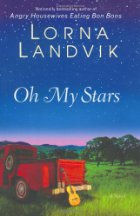
Thoughts on Oh My Stars by Lorna Landvik

Or, "The blogger objectivity debate comes home to roost." 

Random.org must have a sense of humor because it was supremely funny that Oh My Stars by Lorna Landvik happened to be the book that I was reading the most recent time the whole "blogger reviews aren't objective enough" thing came up.  A thing which, from my reading of it, has much less to do with actual objectivity and subjectivity than it does with some bloggers liking to get out their snarky face from time to time and have a roast/public shaming of an author whose book they found to be atrocious.  I, of course, don't sanction the whole merciless snarking of any unfortunate authors under the guise of "reviewing" their books regardless of whether said books are or aren't atrocious in one person's or even several people's opinions, but I do think a review is by nature subjective, and nothing could illustrate that better than my experience with Oh My Stars. 

Really, it shouldn't take any measure of genius for you to realize that what you're getting here when I review (if I dare be so bold as to call my discourse on books here reviewing, which, um, I do) a book is my opinion.  I can dress it up all pretty with flowery language and the occasionally overused pretentious book reviewerly phrases.  I can back it up with what I consider to be solid evidence from the book itself.  I can balance the "good" and the "bad" aspects of the book for you and event point out the more winning aspects of some of the books I really didn't end up liking at all, but at the end of the day, you're getting one thing.  My opinion.

So, here's Oh My Stars, the story of a young girl named Violet growing up during the Great Depression.  She was never a pretty girl to start with, and when she loses her arm in a factory accident (this is not a spoiler, it happens on pretty much the first page of the book), she can no longer bear the torment of schoolmates and family alike who malign her missing arm, her horsey face, her somewhat freakish height.  Determined that life is no longer worth living considering that nobody loves her, not even her no-good father, she gets on a bus and sets off for California where she has decided to pitch herself off the Golden Gate Bridge.  Before that can happen, the bus wrecks in a nowhere sort of town in North Dakota, and the path of Violet's life changes forever.  Before she knows it she's managing a the hottest new band that's breaking down barriers to racial integration all over the states and finding love in a place she never would have expected.

If I were going to sit here and type you up an "objective" review of Oh My Stars you would probably wonder why I even passed the 50 page mark without jettisoning it in favor of more quality reading.  It would be no great challenge to snarkily tear it page from page telling you all about how Landvik relies on a healthy dose of stereotype, depends on you to suspend a great deal of your disbelief, and exaggerates her characters to caricature-like proportions at times.  I could point out that the things that happen to Violet are always either so very bad or so very good that it seems totally improbable.  I could ponder the lack of a realism in that a band composed of both white and black members could play clubs in the Deep(ish) South in the 30s and somehow play such good music that nobody got killed.  You could then comment that "gosh, this book sounds rotten.  I wouldn't touch it with a ten foot pole," and we could close the door on the whole matter.

There's just one thing, though.  I really liked it.  Despite its many flaws, if I had to pick my best book of the year so far, it's likely this one would take the cake ahead of several books that in writing and style are technically much better.  But, Oh My Stars, it just has a certain je ne sais quoi that I quickly embraced.  Maybe it's Landvik's conversational writing style that flows without interruption and makes the book hard to put down.  Maybe it's the foreshadow-y way she uses Violet's first person voice looking back on events interchangeably with a third person that gives the bigger picture as events unfold.  Maybe it's the characters who, when not wandering about in caricature-ville, are original, compelling and lovable.  I loved Kjel's optimism and his willingness to love even the most unlovable.  It was refreshing to read about a guy who was good but not perfect. I loved Austin whose expansive vocabulary is the exact opposite of what people would expect from a black man in the 30s.  I even loved Austin's prickly brother Dallas, who could be funny as often as he could be cruel.  Watching Violet blossom from the closed up, hopeless, angry person she started out as into the strong, funny girl who can negotiate contracts with club owners is also a pleasure.  The unlikely foursome's idyllic summer together seemed as enchanting to me as if I was there myself, and I was swallowed up by the lives of three passionate musicians on the road making a name for themselves.  I was so taken by Oh My Stars that I laughed and I cried, and I was sad that it was over even if my objective mind could recognize flaws popping up all over the place.

What's a good, objective book reviewer supposed to do with that?  I'm not sure if I would have recommended this to myself much less to other people.  Objectively, I would have to acknowledge this book is far from perfect, but my good old-fashioned subjective opinion in hindsight is that it's a fine read that I'm so glad I didn't miss.  I guess that leaves it up to you to decide!  ;-)


Monday, January 9, 2012

Tiger, Tiger by Lynne Reid Banks

Come one, come all to the new year in Leafing Through Life book reviewing, wherein I attempt to perform the astonishing feat of reviewing the last book I finished before flipping the last page of my current read. In keeping with the new year, my very first book, Tiger, Tiger by Lynne Reid Banks came from my very own shelves (or maybe I mean "from a cardboard box that's become an extension of my shelves"). Actually, it was not quite the very first book of the year seeing as Greg Iles' Blood Memory and Massimo Carlotto's The Goodbye Kiss both got the axe before Tiger, Tiger finally passed the 50 page test with flying colors. Here's to at least making room for the books in the boxes. Oy.

Tiger, Tiger starts off with a bang as two young tiger cubs are torn from their lush jungle home and dropped into the unknown of Ancient Rome. One is destined to fight for its life in the Colosseum, the other is bound for a much cushier life as the showy pet of the Caesar's beautiful young daughter Aurelia. Little does Caesar know that his twin tigers will prove the catalyst for some most unusual and unwelcome happenings, and that when circumstances bring the two cats together again, the results could change an empire.

The tigers, who are important enough to the story that they command a portion of the narration all to themselves, are ultimately a backdrop for young Aurelia's story. Aurelia, daughter of the most powerful ruler of the most powerful empire, at 12 years old is already beautiful and even wise for her age. She knows that even though she is young, the effect of her power on servants and slaves is profound. She is too beautiful to be even be left alone with any man without her father's express permission, so when her new pet tiger comes with a young male keeper, the chain of events is not unsurprising, but young Julius is a slave, and Aurelia, while just within reach, is strictly off-limits.

Tiger, Tiger, though it tends toward the overly predictable, is still an enchanting piece of middle grade historical fiction that follows a princess as she comes of age in Ancient Rome. Banks' Rome is vividly portrayed both in its opulence and its barbarism. Aurelia's personal space is vast, and her tiger, Boots, is given a bejeweled collar even while slaves, gladiators, and Christians are sent into the Colosseum to be mauled to death by Boots' brother Brute all at simple thumbs up or thumbs down from Aurelia's father, the all-powerful Caesar.

Through Aurelia's eyes, the terrors of the Colosseum are revealed with happenings so awful and disgusting that Aurelia is left unable to so much as look her father in the eye with love. The love story is sweet, chaste, and ultimately more powerful than expected. Aurelia herself is a great character, gentle and caring and quite unprepared for the barbarism that sustains her father's empire. She possesses the perfect marriage of childish foolishness that has far-reaching implications and a wisdom beyond her years as she navigates her growing knowledge of the awful things her father's and her own power is built upon.

Tiger, Tiger is a captivating story of much more than just tigers that opens a window on Rome that will make ancient history accessible and even enjoyable to younger readers - and older ones, too.

Tuesday, October 20, 2009

The Center of Everything by Laura Moriarty

This is my second Reading at Random book, which is part of my quest to read books from my own library totally at random.


Now that I've read The Center of Everything, I've officially read two books by Laura Moriarty, and I can honestly say that I have a terrible love hate relationship with them. When I finished The Rest of Her Life, the first of Moriarty's books that I've read, I thought I didn't like it. I put it down thinking, "well, that was unsatisfying." Then, it marinated in my head for days and days and stuck with me in a way most books don't, and I'm afraid that The Center of Everything is going to do the exact same. Now, none of this is to say that these two books are bad books, rather they are two very good books with characters whose thoughts and feelings and heartbreaks became my own thus making the books weirdly personal for me and so that much harder to review.

I leave her books feeling like I know Laura Moriarty's characters, and I feel their pain, and I can absolutely relate to them in impossible ways. It seems, then, that Moriarty's books cut me so deep that it actually makes them hard for me to read and hard for me to say that I "like" even though its obvious that Moriarty is the best of writers, capable of engaging readers like me in ways beyond the ordinary. I never cried, but my heart broke over and over again for Evelyn, the main character of The Center of Everything, and for several other characters as well.


Evelyn is growing up in Kerrville, Kansas, which for all intensive purposes is, even on the map in her classroom, the center of everything. Evelyn has a childhood crush on the bad boy next door, loathes the cool girl in her class, and so badly wants to grow up and fulfill her potential so she won't turn out like her mom, whose string of bad decisions has alienated Evelyn. This is the story of Evelyn's life as told by Evelyn herself as she navigates life's rough waters into adulthood, and it's a very stormy sea. Nothing terribly extraordinary happens within these pages, but Evelyn's candid, believable voice pulls readers into her story and makes them feel for her and for the people around her as she rides out the frequent heartbreaks and occasional joys of growing up. Evelyn has a lot to learn about love, about compassion, and about the gray areas that lurk in our daily lives where there just doesn't seem to be any definite right or wrong to go by.

I don't say anything, but in my head, things have changed. I've drawn a line between us, the difference between her and me. It's like one of the black lines between the states on maps, lines between different countries on the globe. They don't really exist. You don't really see a long black line when you cross from the United States into Mexico, from Kansas to Missouri. But everyone knows where they are, and they are important, keeping one state separate from the other, so you can always tell which one you're in.

Moriarty's knack for portraying the blunt reality of life is unequaled. She allows us no safe place and rubs salt in all the raw wounds of any of us who have ever suffered broken hearts or embarassment or disappointment. She always shows and never just tells with her writing. Moriarty's characters are needy but proud and selfish, and when they desperately need each other the most, they can't seem to keep from missing each other's advances or hurting each other even more. In other words, within the pages of The Center of Everything they become absolutely real, living, breathing people that we come to care about. When they start to make peace with their lives, we breathe a small sigh of relief because if they can, maybe we can, too.

I definitely recommend this, if only for Moriarty's ability to capture the powerful story that lurks even in the most ordinary lives.

How about you? Have you ever read a book (or books) that touched a nerve with you? A book that you knew was good but was still hard for you to read?

Wednesday, July 1, 2009

Reading at Random: Lake News

In an age of ARCs, book tours, challenges, readings lists, and neverending prize-winner projects it seems we've lost something, or at least, I have lost something. Gone are the days when I could just wander up to my bookshelf and select a book totally at random and sit down and read it. This and a plethora of books that are leftover from days when I read different sorts of books than I do now, have prompted me to consider a new method of picking books to read, at least, on occasion. Of course, it can't be so simple as my simply walking up to a shelf and picking a book to read lest I do the obvious and pass by those books that I'm not sure I'm interested in anymore yet can't seem to get rid of on the offhand chance that I might still like them. Some mental block precludes me from simply casting them off without even putting them to the 50 page test. Obviously, at some point, I thought I would like each and every one of these books, else why would I have bought them to take up space in my house? Also, I might accidentally forget to randomly choose from those books stacked in boxes, tucked in cubby holes of the unused entertainment center or in a random nook of the desk.

So, with the help of my Library Thing library which, I heartily believe and hope is an accurate representation of all of the books in my actual library compiled in one place and the ever-useful Random.org, I have devised a way to make myself read my books. It's all very simple, really. Just sorted my library by rating so I knew how many pages of books I had that I hadn't read and a few randomly generated integers (one to choose the page of 50 books, another to choose the one of 50 on the chosen page) later, I had a book. The only caveat, then, was that regardless of the book it chose, I had to unearth it from the stacks and give it at least 50 pages to hook me. If it didn't, I could be free of it. If it did, well, then I finish it! It's a little fun, a little scary, and a lot unpredictable. And I think it might just work as a means to help me work through my stacks of unloved TBR books.

Thus was born another totally erratic, possibly never recurring (though I hope it will) feature and a creative way of justifying reviewing sorts of books that I almost never seem to read anymore. This one, however, has a pretty picture. See? Pretty, no? We'll say it's even random because you can't see the titles of the, uh, random books, if you will. And the words go funky directions! Don't laugh - you can't imagine the untold hours it took me to make that. I'm good with words, not pictures, okay?

Alas, the system did just what I hoped and didn't hope it would do. It picked for me a book that's been on my shelves for as long as I can remember that I was pretty sure I could knock out with the old 50 page test, Lake News by Barbara Delinsky. A little romance. A little intrigue. A little more "commercial" than my average read as my mother so insightfully pointed out when I took it with me on vacation. So with some trepidation, some cynicism about my past reading tastes, and not a little distaste (I have all these great books and I'm reading this?) I started in on my 50 pages and found that I read past the 50 page mark in no time at all. That's right, I read it to the bitter end and proved myself right in my total unwillingness to cast off the untried book. Okay, so maybe it's not a marvel of literary art, but I was engaged, I did like the characters, and what woman can't go for a little romance once in a while, even if it's just in a book? (Especially if it's just in a book?)


Lake News is the story of Lily Blake whose passion is for music and for performing. She has a comfortable, if not extravagant, life in Boston where she teaches music at a private school and moonlights as a singer in a posh dinner club. All that changes when an off-the-record conversation with a reporter about her friend, a newly promoted Cardinal in the Catholic church, is twisted into a libelous front page story of her supposed affair with the Cardinal. Suddenly, Lily's life is crumbling around her as countless reporters hound her and dismantle the reputation she has worked so hard to build for herself in Boston. Before long the negative publicity drives both her bosses to fire her, and she becomes a virtual prisoner in her apartment where even her neighbors are in a fury at the hoards of reporters laying siege to her building. Soon, Lily knows she has no choice but to return to the small hometown she wanted nothing more than to escape. But what will she find on the shores of Lake Henry? Will the denizens of her old town protect her or turn on her? Will she be able to patch up longstanding problems with her mother? And why does John Kipling, editor of the town's weekly Lake News, keep turning up? Is he looking for a story? Or is it something more?

This is not the sort of book that it takes rocket science to figure out. As a matter of fact, I'm sure you can guess just about all the answers to my questions. That said, though, I actually quite liked this book. Both Lily and John are fully fleshed out characters struggling with scars from the past and hurts from the present, each looking to somehow prove their worth to themselves and to their still difficult parents. It's easy (or perhaps I mean difficult?) to feel Lily's pain as her life is stolen out from under her based solely on lies and easy to know her uncertainty about how to go about remedying the situation. Lake Henry and its citizens are good-hearted, close-mouthed when it counts, and refreshingly quaint in that small town way. Delinsky's story has a great flow, unloading bits of intrigue and leaving a trail of romantic encounters between John and Lily that carries readers along to its satisfying conclusion. No, it's no literary masterwork of the sort that I usually read (LOL!), but it is a refreshingly good story that leaves you feeling fulfilled in a way that those literary fiction types with frustratingly ambiguous endings can't do.

--------

So, there you have it. My first experience with reading randomly, and an oddly rewarding one at that. Are you searching for an escape from your regimented reading schedule? Feel free to join me in reading at random. Perhaps you'll find it as refreshing as I have. It's not your method of random choosing that matters so much - I've obviously taken my randomness to the limit (though I do recommend this method which is so very...random) - as long as you're reading a book that you are in no way obligated to read whether that obligation is to yourself and some insane book list you've made or to authors, publishers, challenges, or even friends. Here's to making reading a little more random again!