Tuesday, November 29, 2011

The Water Wars by Cameron Stracher


That's why I'll never forget the first time I saw Kai. He was standing in the open road drinking a glass of water like it didn't matter - water from an old plastene cup.

When Vera first spies Kai, he is dumping the remains of a cup of water into the dust near her Republic of Illinowa home. This very act is unheard of, illegal, grotesque even, in a world where severe water shortages have divided what was the United States into several warring republics. In Vera's world, the Breadbasket of the United States has been transformed into desert, the moisture-less air is practically poison to breathe, and most adults can be referred to as "shakers" because the years of constant thirst have taken their toll. Kai is a mystery. The son of a driller, he travels in a limo with a bodyguard, yet relishes the humble company Vera and her family have to offer. He even claims to know the location of a secret river, something that has fallen to the status of mere myth in a world where people depend on the government's paltry rations of the world's remaining water to survive. Unfortunately, before Vera can figure out Kai's story or her feelings for him, he disappears.

The Water Wars by Cameron Stracher is a fast-paced, thrill a minute dystopian that leaves virtually every chapter at a cliffhanger as Vera and her brother, Will, embark on a desperate, often nearly hopeless journey to find Kai. In their journey, they come upon all kinds of humanity from the unexpectedly righteous to the dangerous to the greedy and merciless, all locked in a battle for water and wealth that must be won by whatever means possible. Stracher's world without water is terrifying. The greed and power-mongering caused by such a severe shortage of what we truly require to survive is realistically drawn. Stracher's vision of the political and economic implications of the panic caused by the dwindling of one resource nations once treated as infinite is wholly believable.

Unfortunately, much of the rest of the book isn't. Maintaining such a fast pace to the story results in a great many contrivances. The times that Will and Vera are saved from an impossible situation at the last possible second by an unlikely occurrence are practically innumerable. In fact, the very premise of the story asks readers to rely on a quickly and thinly constructed fascination with Kai's improbable knowledge of where to find water and a possible blooming romance between Vera and Kai. The beginning rushes through this crucial set-up period, and this makes Will and Vera's sudden eagerness to find and save Kai on their own seem that much more inexplicable. Vera herself is a lovable enough narrator that you can't help cheering on, but the lack of a very distinctive voice makes it seem that the story could just as easily have been narrated by anyone.

Until the politics and economics are fleshed out midway through the novel, Stracher's future feels a little flimsy, driven more by the awkward renaming of everyday things than by explanation. Inexplicably giving something old, a clever new name doesn't quite manage the daunting task of creating a future earth. For example, the pedicycles Will and Vera use to get around. There's no reason given to think that a pedicycle is anything more than a simple bicycle with a new name that seems meant to say "Hey, look, it's the future. We call things different names now." That said, I will say that the new name for synthetically produced avocados - quasi-vocados - put a smile on my face.

Despite some problems, The Water Wars is an entertaining, extremely fast-paced adventure that readers will race through. Stracher's got a good handle on the way human nature might restructure a world with a profound shortage of water - the wars that would take place, the companies that would spring up to take advantage of the situation, the bribery and thievery that would become a daily threat to society. For readers who might prefer a more action-packed dystopian story than the more slow-burning, character-driven ones that I seem to prefer, The Water Wars has all the right stuff, but this reader was left just a little lukewarm.

(Thanks go to the publisher, Sourcebooks, for providing me with a copy for review.)

Tuesday, November 22, 2011

The Grapes of Wrath by John Steinbeck

Or, "Look, Megan Read a Classic!"

Yes, this happens once in a while. I actually sit down and read a book that has gained some notice as a classic of literature. Usually, it's my book group's fault. I require a little extra motivation and explanation to attempt a classic, so when the book group that I on again off again participate in reads one that I already have on my shelf, I attempt to join in. That is how it came to be that I killed almost all of September reading The Grapes of Wrath which, I think, would throw a curve at the speediest of readers. You see, I like a good depressing book, but The Grapes of Wrath tends toward the downright frustrating, and September was a frustrating, depressing sort of month to start with, without dealing with the Joad family's Great Depression misfortunes.

Once upon a time, I read Steinbeck's East of Eden, and to this day, should you ask me to tell you my favorite books, it would make the list. In high school english classes whenever I was handed a reading list of classics from which I could choose my own book, rather than having a specific one assigned, I had an astonishing habit of picking books for myself that I loathed far more than the ones specifically assigned. I don't know if it was pure bad luck or if I just didn't know my tastes so well back then, but it was almost a guarantee that if I chose the classic myself, it would surely not be a good match for me. Then, one time, I chose of East of Eden, a doorstopper of a book that everyone thought I was crazy for attempting, and I somehow loved it. I remember tuning out everything going on in the cafeteria and even reading it at lunch, so absorbed was I in the story. Having enjoyed E of E so much, I've long meant to read The Grapes of Wrath, it being, arguably, Steinbeck's more widely appreciated novel. I'm sad to report that it didn't have the effect that E of E did on me, but that's not to say that I, too, didn't appreciate it.

(Ahem - be aware, there are probably a few spoilers in here somewhere...)


In The Grapes of Wrath Steinbeck tells the story of one family, the Joads, who have been evicted from their dry Oklahoma land during the Great Depression and have been forced to choose to migrate to California where there are supposedly jobs for the taking in a veritable land of milk and honey. Steinbeck introduces us to the Joads as they hopefully make ready to travel the width of the country in a cobbled together jalopy with what little money they were able to get from selling off most of their belongings. In dialogue rich with realistic dialect, we come to know Tom, recently paroled from prison for killing a man; his Pa, a man nearly beaten down from his circumstances; Ma, a woman with an iron will who will stop at nothing to keep her family from falling apart; his sister pregnant Rose of Sharon whose husband is full of dreams for their future; and Uncle John who has spent a lifetime trying to face or escape his imagined sin. Through the pages, readers come to an intimate knowledge of the family as they head west helping who they can though they are struggling to make it themselves. It's perhaps because readers come to know and love the family in all its strengths and its failings that makes The Grapes of Wrath a difficult read to swallow.

Each time it seems that the Joads might finally catch a break, the work dries up, the stream floods, the picking doesn't pay enough for even one decent meal. Tragedy follows in their footsteps, and it's infuriating because despite the fact that you know somewhere in your mind that things aren't on track to work out, Steinbeck's populist rhetoric and his assurances that the men are still angry, and therefore not beaten, gives readers reason to hope that things can and will turn around. There is always a growing impression that perhaps finally the men are ready to combine their great numbers to force the changes that will give them the chance at life they thought they were getting when they set out for California.

There is absolutely no subtlety nor any particular artfulness to be found in the Joads' story. Never for a moment do readers need to wonder where Steinbeck stands on the events that are taking place. Steinbeck is more than eager to hammer his points home as he preachily derides the corporate farmers whose tractors and hired hands eliminate the connection between men and the land that sustains them. He flays California landowners whose vast fields of hardy crops do nothing for the migrants starving for lack of work. He paints heavy handed pictures of people starving in Hoovervilles even while farmers discard crops to to maintain prices.

If, indeed, there is art in Steinbeck's American classic, it lives in the alternating chapters where Steinbeck interrupts his telling of the Joads' journey, to generalize the very much shared experience of the thousands of migrants who fled to California during the Depression. In them, he captures the haggling for a junk car, the staggering number of people heading west fed only on dreams, the growing anger of powerless men, the etiquette of camping, and even the dances that give struggling families a break, however brief, from their sufferings. In these chapters, Steinbeck lets the many voices be heard, he paints pictures with dialogue, and his words even carry the very rhythm of the dance.

There are many things to like and to dislike about The Grapes of Wrath. It is preachy, heavy handed, depressing, frustrating, perhaps even exaggerated, but it is also a profound, and perhaps even hopeful story, of a family's strength in the face of unbelievable struggle. Steinbeck's writing gives poetry to populism, and even now, The Grapes of Wrath has the enduring power to cause the righteous anger that can bring about change that so much of society still desperately needs.

Sunday, November 20, 2011

Pre-Thanksgiving Loose Leafing

Here it is, Loose Leafing take two, wherein I write about whatever I darn well feel like. Look for it to become a regular thing, because, well, I kind of like it. I've got pictures this time. Are we excited?


Choco-Turkey is ready for Thanksgiving. Are you?


It's hard to believe, I mean, really hard to believe that Thanksgiving is only days away and the holiday season is pretty much upon us. As far as I can tell, I've never been less ready. I'm usually a total Christmas nut, but I'm having a hard time wrangling myself into the mood for it despite the fact that I'm busy cramming my schedule full of Christmas-y activities. I got out my Christmas music this week when my new Glee Christmas Album came, but where I'm usually chomping at the bit for Christmas music, this year I'm kind of meh about even that. Here's hoping for some Christmas spirit, pronto!

In follow up from last time's Loose Leafing post, not only is the Rockefeller Center Christmas tree indeed taken from somebody's yard in a town across the river from where I live (10 minutes away tops), it also happens to have belonged to my mom's great aunt, which apparently I probably shouldn't admit to because in the interviews the family's done, they've made us all look like a pack of bumpkins. But, whatever, I'm totally famous by proxy now. You can have my autograph. For a small fee, of course. ;-)

I am getting excited about Thanksgiving though, especially with the arrival of Choco-Turkey. Choco-Turkey is, by far, the best of my family's newer holiday traditions. A couple years ago my parents and I were window shopping in a small local town and wandered into a Purity Candy store where we discovered that they make chocolate turkeys in all sizes. Obviously, when one sees a large chocolate turkey, one must have it, so we got one that year and have gotten one every year since. It drives my younger cousins crazy having to wait for someone to liberate Choco-Turkey from his wrap and chop him up into reasonably sized pieces, and with good reason, because Choco-Turkey is delicious.

Here's a sad, sad story. I can't wait for re-runs on TV. You see, I love TV too much, or at least my parents do, and since I live with them and am a sheep, I love it by default. During the summer months my mom mourns the loss of new TV episodes while I can barely contain my glee because, at last, I've got free time for other things, you know, like this reading and blogging stuff that I love so much. Each year, I am determined to add fewer shows to my TV watching plate which, this year in particular, has been a dismal failure. You see, there are too many good new shows that I just had to add to my already overflowing crop of old favorites. Now I'm hooked on Pan Am, Once Upon a Time, Revenge, and The New Girl in addition to all the old favorites - Castle, Criminal Minds, Grey's Anatomy, Private Practice, The Big Bang Theory, The Mentalist and more(!!). Yikes! So, yeah, I need a few holiday season re-runs to get my life back on track and my Christmas shopping done. What excellent TV shows are you into this season?


In reading news - I am actually managing to fit in some of that too (thank goodness for lunch breaks!) - I finished The Legacy by Katherine Webb which I think I actually appreciated more for my being a slow reader (for a change). I'm near to finishing Cameron Stracher's The Water Wars which is entertaining with a few drawbacks. In between, I've been shuffling in a story or two by various authors from The Chronicles of Harris Burdick based on Chris Van Allsburg's mysterious illustrations. The stories are deliciously fantastical and not to mention slightly off-center, and I'm much enjoying my brief interludes with them.

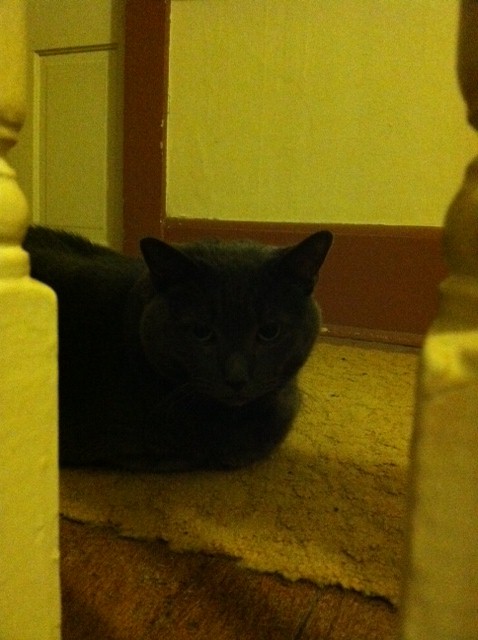
Now, I'll leave you with a picture of my cat because that's what all the cool bloggers do, right? It's not a particularly good picture, I swear my house isn't that sickening shade of yellow, though I'm sad to admit that the carpet unfortunately is. I took this picture through the banister rungs on the stairs where Merlin tries to attract some love and attention and (now) photo-ops from unwitting passers-by.


Here's Merlin. That's his "fat, dark, and catty (not to mention legless)" look.


Hope you all have a great week and a happy holiday (if you're celebrating on Thursday)!

Tuesday, November 15, 2011

Top Ten Tuesday: Books That Have Been on My Shelves Forever


I like today's theme for The Broke and the Bookish's Top Ten Tuesday. It's all about those books that have spent many long years on our shelves but have never managed to get read. It definitely lead to the dawning realization that I have had some of my books for a looooong time, so long that I don't even know when or how I came into possession of them, only that I've also intended to read them for a loooong time. Here are some of my more long-neglected books...maybe you can help me decide if they're really worth hanging onto for that elusive future read!

1. The Poisonwood Bible by Barbara Kingsolver - I think this one landed on my shelves back in the major heyday of Oprah's Book Club when my mother and I were discovering the wonderful world of literary fiction. I want to read it, but I've read so many mixed reviews that I'm kind of skeptical.

2. Interview With the Vampire by Anne Rice - I can't remember a time when this book wasn't on my shelf. Most books I can at least remember when I acquired, not so with Interview With the Vampire. I saw the movie and liked it, and I've always wanted to give the book a shot, but then the mass market paperback has super tiny print that always manages to scare me off before I get very far.

3. A Son of the Circus by John Irving - This is the first of many John Irving books that I've purchased over the years that I've subsequently never read. Luckily, my mom's kind of a fan, so they're not all going to waste while they await my attentions.

4. Skeleton Crew by Stephen King - I love Stephen King, and I've even started this book a few times. The first story, "The Mist," I've read several times, and it's deliciously disturbing, but I never seem to get much further.

5. Seize the Night by Dean Koontz - I should probably just get rid of this one, but Dean Koontz is one I go to for easy (dare I say "comfort"?) reading whose books I tend to enjoy if I can manage to get past his wildly awkward metaphors.

6. Marlfox (Redwall Book 11) by Brian Jacques - The Redwall books were some of favorites when I was younger, but despite the fact that I've kept collecting them over the years, they've kind of fallen into that abyss between what I used to read and what I read now. I'd love to read the rest of the series, though, and this is about where I left off. In fact, I wouldn't mind reading this whole series all over again. It's full of good memories!

7. The Chamber by John Grisham - When I was in high school, I looooved John Grisham. I spent a few good nights with the likes of A Time to Kill and The Client. I haven't read Grisham in forever, but I can't bring myself to part with this one that my parents say is their favorite of his books. Unfortunately, I haven't quite managed to read it yet, either.

8. And the Band Played On: Politics, People, and the AIDS Epidemic by Randy Shilts - As I was combing my collection for the long-neglected I noticed this one that's been gathering dust on my shelves for far too long, has an impressive 4.38 stars rating on Library Thing. When I stop being such a slacker about reading non-fiction, I think this one should probably be up first!

9. Outlander by Diana Gabaldon - I've heard so many good things about this series that I have half of it sitting on my shelves. I've got a total thing for Scotland, so this is probably going to be right up my alley, but it's kind of hunormous and therefore inconvenient to carry to work for lunchtime reading and therefore has been sitting neglected on my shelves for far too long.

10. She Walks These Hills by Sharyn McCrumb - I started reading Sharyn McCrumb's mysteries set in Appalachia in high school, too, starting with The Hangman's Beautiful Daughter which I really liked. I've been collecting them ever since. Soon maybe I'll even read them starting with this one that I've had the longest.


So - those are the books that have been awaiting my reading attentions the longest. Have you read and loved any of them? Are there any I should just give up and chuck on the donation pile?

Sunday, November 13, 2011

The Future of Us by Jay Asher and Carolyn Mackler

It's hard to believe that 10 years ago, there was no Facebook. We didn't live to take the better, more exciting profile picture. We didn't endlessly overshare our lives in sentence-long status updates. There was no one writing on our Walls, "liking" our posts, or tagging embarassing photos of us. It wasn't nearly so easy to "stalk" the people we knew back when. In fact, it was nearly unimaginable to think that we'd share so much of our lives in a place where everyone could see. Imagine how much you could find out about yourself if you stumbled upon your future Facebook page years before Facebook was even invented, and then you've stumbled upon the clever premise of The Future of Us.

It's 1996 when Emma gets her first computer, and when her next-door neighbor, Josh, stops by to volunteer one of those America Online 100 free hours CD-ROMS, Emma dutifully waits out the hours long install, and dials up to the internet (Ah, the good ol' days!). Upon logging on for the first time, Emma mysteriously stumbles upon, you guessed it, a Facebook page for a woman that seems stunningly like her. In fact, it is her, only 15 years in the future. Thinking it's a stupid prank, Emma demands that Josh look, too, and soon the pair are wrapped up in their future lives which are being all-too-easily altered by even the smallest ripples of what they are doing in 1996.

The Future of Us is a clever tale that should have wide appeal. Readers from my generation who remember logging onto AOL for the first time with the sound of a dial-up modem ringing in their ears will get a kick out of all the vaguely nostalgiac references to the things that remind us of our own teenagerhood. I mean, who doesn't get a laugh out of the stone ages when we had to get off the internet if we wanted to make a phone call, at least until we got that coveted second phone line? Today's teenagers should fall in love with Emma and Josh, neighbors and former best friends whose relationship has grown more than a little awkward since some signals were misread and hearts were broken. It's easy to relate to these two teens who are neither super popular nor super losers.

Whether you're young or old, it's not hard to understand Emma's obsession with whether she'll be happy in the future and Josh's desperation to hang on to a future that's beyond his wildest dreams. The suspense of waiting for their next look into their futures keeps the pages turning even as the tension of preserving or obliterating their Facebook futures drives the two friends apart. Asher and Mackler's story pops with realistic dialogue and is a fun read that reminds us that happiness isn't out there somewhere waiting to happens, sometimes it's right in front of our eyes.

The Future of Us hits bookstore shelves November 21st.